
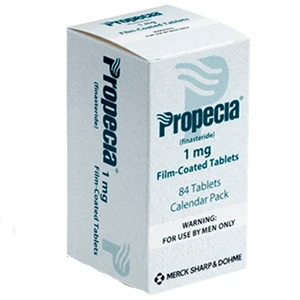


Propecia (Finasteride)
$18.65
Propecia (finasteride 1 mg) is a medication used to treat male-pattern hair loss (previously known as male-pattern baldness). Propecia is a trusted, evidence-based option for those looking to slow, stop, and even reverse hair thinning.
Delivery & Privacy
- Fast next‑day delivery to get your products as soon as possible.
- All items are packaged discreetly to maintain your privacy.
What is Propecia?
Propecia is a prescription treatment for male-pattern hair loss (androgenetic alopecia) in adult men. It contains the active ingredient finasteride 1mg, a prescription-only medicine that targets the hormonal cause of hair thinning. Propecia tablets are taken once daily and are designed to help slow hair loss. For many men, Propecia has also helped to promote hair regrowth.
Finasteride has been studied in large clinical trials involving thousands of men and has been shown to be a safe treatment that delivers noticeable improvements for the majority of men who take it. It is specifically licensed for hair loss at the 1mg dose and should not be confused with the higher dose finasteride used for prostate conditions. Propecia is suitable for men experiencing thinning at the crown or mid scalp.
How Does Propecia Work for Hair Loss?
Propecia works by reducing levels of dihydrotestosterone (DHT), a hormone derived from testosterone that plays a central role in male-pattern hair loss.
In men who are genetically sensitive to DHT, this hormone gradually shrinks hair follicles in a process known as follicle miniaturisation. As follicles become smaller, the growth phase of the hair cycle shortens. Over time, hair becomes thinner, shorter, and less pigmented, eventually leading to visible thinning or balding in affected areas.
Propecia 1mg blocks the enzyme 5-alpha reductase type II, which converts testosterone into DHT. By lowering DHT levels in the scalp, Propecia helps protect your hair follicles from further shrinkage. This can slow the progression of hair loss and can also improve hair thickness.
With daily use, scalp DHT levels are reduced by roughly 60-70%. Continued treatment is necessary to maintain these hormonal changes and preserve results over time.
How Long Does Propecia Take to Work?
Results from hair-loss treatments vary from individual to individual. Propecia usually begins to work after 3 months of continuous use. However, some people report that it may take more than a year to notice a significant change in hair density and coverage.
One study indicated that 99% of men taking 1mg of Finasteride (the active ingredient in Propecia) daily for 5 years had noticeable improvement on photographic assessment. Regularly missing doses of Propecia may reduce the medication’s effectiveness, meaning visible changes may take longer to occur.
Propecia Results for Hair Loss
Propecia is a rigorously studied and clinically proven treatment for male-pattern hair loss. In large-scale, randomised, double-blind, placebo-controlled clinical trials lasting up to five years, Propecia demonstrated significant clinical benefits compared with placebo groups. These studies highlight that the medication works by targeting the root cause of male pattern hair loss: the hormone dihydrotestosterone (DHT).
Key findings from major Finasteride (Propecia) studies include:
- Stopping Hair Loss: After one year of consistent daily treatment, the majority of men experienced either a measurable increase in hair count or no further hair loss.
- Visible Regrowth: Clinical trials showed that approximately 65% of men had visible improvement after two years of treatment, compared with only around 7% in the placebo group.
- Increased Hair Density: Hair count measurements in vertex scalp studies revealed an average increase of approximately 100 hairs in a defined 1-inch target area after 12 months.
- Long-term Benefits: One study noted that 99% of men taking 1mg of Finasteride for 5 years had noticeable improvement on photographic assessment.
Propecia is most effective in men with mild to moderate hair loss and tends to produce the best results at the crown (vertex) and mid-scalp rather than the front hairline. It is important to remember that hair growth is a slow physiological process. Consistency and ongoing use are key to treatment success with Propecia.
How to Take Propecia 1mg Tablets
Propecia should be taken exactly as prescribed. The usual dose is one tablet taken once daily. It can be taken with or without food, but should be taken at the same time each day for consistency.
Results are gradual and typically become noticeable after three to six months of continuous use. Treatment must be continued to maintain benefits. If Propecia is stopped, any improvements in hair growth are usually reversed within 6 to 12 months.
Propecia Dose for Hair Loss
The recommended dose of Propecia for male pattern hair loss is 1mg once daily. There is no evidence that taking more than the recommended dose improves effectiveness and may, in fact, increase the severity of side effects. Tablets should be swallowed whole. Consistent daily use is important for maintaining reduced scalp DHT levels and preserving ongoing hair growth.
What if You Forget to Take Propecia Hair Tablets
If you don’t take your regular dose of Propecia, take it as normal the following day. Never try to take a double dose to make up for one you have forgotten. If you regularly forget to take your medication, your clinician may be able to offer you advice and support.
If You Take Too Many Propecia Tablets
Should you accidentally take too many Propecia hair tablets, seek medical advice from your clinician or doctor immediately. The treatment will not work faster or better if you take it more than once daily, so always stick to the schedule your prescriber gave you.
If You Stop Taking Propecia
It’s important to keep taking Propecia hair tablets for as long as your prescriber tells you. If you stop using the medication, you are likely to lose the hair you have gained within 9 to 12 months. More information about what happens if you stop taking finasteride (the active ingredient in Propecia) is available in our dedicated guide.
Propecia Side Effects and Cautions
Like all medicines, Propecia can cause side effects, although not everybody will experience them. Some of these adverse reactions will be temporary or will disappear when treatment is stopped, while others could continue after you stop taking the medication. Propecia is not suitable for everyone. You should therefore have a clear understanding of what to expect before you start using Propecia tablets.
Side Effects of Propecia
Although Propecia is typically well tolerated, side effects can occur. Tell your doctor or prescribing clinician if you experience side effects from the medication, as they can advise on managing them or suggest an alternative medication.
Potential Propecia side effects include:
| Uncommon
(may affect up to 1 in 100 people) |
Frequency Unknown |
|---|---|
| Inability to have an erection (impotence) Loss of libido (less desire to have sex) Problems with ejaculation (decrease in the amount of semen released) |
Breast swelling or tenderness Palpitations (feeling your heartbeat) Changes in liver function, which can be shown in a blood test Pain in the testicles Blood in the semen Male infertility and/or poor quality semen Anxiety Suicidal thoughts |
Please note that the table above does not contain a complete list of potential Propecia side effects. More information can be found in the Patient Information Leaflet that comes with the medication. If you experience any adverse reactions to the treatment, you can report them via the MHRA’s Yellow Card Scheme.
How to Reduce the Side Effects of Propecia?
You must tell your doctor if you are experiencing side effects from Propecia, as you may need to stop taking it. However, after consulting a doctor, the impact of certain side effects may be reduced with a few lifestyle changes. These include regular exercise, weight loss, and increased Vitamin D intake. More information is available in our dedicated guide all about managing Finasteride (Propecia) side effects.
When to Inform a Clinician
Stop taking Propecia tablets and talk to your clinician or doctor if you experience any of the following side effects:
- Symptoms of an allergic reaction (swelling of your lips, face, tongue, and throat, difficulty swallowing, lumps under the skin, and breathing difficulties)
- Depression (feeling of severe sadness and unworthiness)
You should also report any changes in breast tissue, such as pain, enlargement, lumps, or nipple discharge, as these could be signs of a serious condition.
Long-Term Effects of Propecia
Some side effects from Propecia are temporary or will resolve after treatment is stopped. However, certain physical, sexual, and psychiatric side effects can persist for more than 3 months; this is called Post-Finasteride Syndrome (PFS). Symptoms may include loss of sex drive, difficulty having and maintaining an erection, difficulty with ejaculation, poor semen quality and infertility, testicular discomfort, enlarged breast tissue, loss of energy and strength, decreased mental agility, depression (including suicidal thoughts), anxiety, and difficulty sleeping.
PFS is still under-researched. The likelihood of persistent symptoms and any associated risk factors is not fully known. If you are concerned about the potential impact of PFS, speak to your clinician before starting Propecia.
Propecia Warnings and Interactions
Propecia is a trusted treatment used by many men experiencing hair loss. However, it is not suitable for everyone. Review the following safety information carefully to learn about important risks to watch for. Speak to your doctor to find out if Propecia is right for you.
Propecia Prescription Criteria
Propecia is prescribed for adult men aged over 18 who are experiencing male-pattern hair loss. It’s not suitable for women or children. A clinician will assess hair loss pattern, medical history, and potential contraindications before prescribing. It is not used for sudden or patchy hair loss.
Who Should Not Take Propecia Tablets
Although Propecia hair tablets are generally well-tolerated, they are not suitable for everyone. You should not take the treatment if you are:
- A woman, as Propecia does not work in women with hair loss
- Allergic (hypersensitive) to finasteride or any of the other ingredients in the medication
- Are already taking finasteride or dutasteride for a prostate issue called benign prostatic hyperplasia (BPH).
You should also consult your clinician or a doctor before taking the medication if you are due to have a blood test for prostate cancer (known as a prostate-specific antigen or PSA). This is because Propecia could affect the result of this test.
Propecia 1mg tablets contain lactose, so it’s important to seek medical advice before starting treatment if you have an intolerance to some sugars. If you are unsure if any of the above information applies to you, speak to your doctor.
Mood Alterations and Depression
Signs of mood change, such as depression and, less commonly, suicidal thoughts, have been reported in men taking Propecia or its active ingredient finasteride. Tell your clinician before treatment if you have a history of depression or suicidal thoughts, as it may mean the medication will not be suitable for use. You should also stop taking Propecia and contact a doctor as soon as possible if you develop a low mood, depression, suicidal thoughts, or other adverse changes in mood or behaviour.
A 2026 MHRA safety alert highlighted that sexual dysfunction, a potential side effect of Propecia use, may contribute to mood disorders such as depression. Sexual dysfunction may occur with or without changes in mood.
Propecia and Other Medicines
When starting a new medication, it’s essential that you tell your doctor about any other medicines you are currently taking or have taken recently. This includes both prescribed and over-the-counter treatments, supplements, and herbal remedies.
You should not take Propecia if you are already taking finasteride or dutasteride for hair loss or another condition called Benign Prostatic Hyperplasia (BPH). The manufacturer advises that there is no information available on the use of Propecia alongside another hair loss treatment, minoxidil (sometimes sold under the brand names Regaine or Rogaine).
Pregnancy
Propecia is only intended for use by men over the age of 18. Propecia should not be taken by women. If you are pregnant or may become pregnant, avoid touching the contents of a broken tablet as the active ingredient, finasteride, can cause birth defects to a male foetus’ sex organs. Whole tablets are coated with a protective film to prevent contact, but care should still be taken. If you are a woman who is pregnant and has come into contact with finasteride, speak to your doctor for advice.
Where to Buy Propecia in the USA and UK
Propecia is available for purchase from licensed pharmacies with a valid prescription. It is important to note that some pharmacies may not supply Propecia, and instead may offer a generic form of Finasteride 1mg.
Choosing a reliable pharmacy is an essential first step when buying medication. The General Pharmaceutical Council keeps an up-to-date register of licensed pharmacies.
Can You Buy Propecia Over the Counter?
Propecia is a prescription-only medication, meaning it cannot be bought over-the-counter without a valid prescription. This is to ensure that it is given safely, after careful evaluation by an appropriately trained prescriber.
Is Propecia Available on the NHS?
Propecia is not available on the NHS when prescribed to treat male-pattern hair loss. This is because it is considered a primarily cosmetic treatment, which the NHS does not fund at this time. Finasteride, the active ingredient in Propecia, is sometimes prescribed by NHS clinicians at a different dose for a condition called Benign Prostatic Hyperplasia (BPH).
Can You Buy Propecia Online?
Yes, you can buy Propecia online without an appointment from reputable pharmacies such as Prescription Doctor. We make the process of obtaining the healthcare you need as hassle-free as possible with our seamless ordering service. Simply complete a brief medical questionnaire, and our clinicians will determine if your chosen medication is suitable for your circumstances.
Once approved, our General Pharmaceutical Council-registered pharmacy will dispatch your item in plain packaging for complete discretion, directly to your chosen USA and UK address. Orders approved before 3pm on a weekday are also eligible for next-day delivery, giving you swift access to your treatment.
Frequently Asked Questions About Propecia 1mg Tablets
What is the Likelihood of Propecia Working for Me?
What is the Difference Between Propecia and Finasteride?
Does Propecia Thicken Thinning Hair?
Propecia can help thicken thinning hair in men with male-pattern hair loss by targeting the hormonal cause of hair follicles shrinking. Lowering DHT levels in the scalp helps prevent further miniaturisation of hair follicles. In many men, this not only slows ongoing hair loss but also allows some weakened follicles to produce thicker, stronger hairs over time.
Clinical studies show that a significant proportion of men experience visible improvement in hair density after several months of consistent use. Results are typically most noticeable at the crown and mid-scalp rather than at the hairline.
Can a Man Take Propecia When Trying to Conceive?
Does Propecia Affect Fertility?
Does Propecia Cause ED (Erectile Dysfunction)?
Erectile dysfunction (ED) has been reported as a possible side effect of Propecia, but it affects a small percentage of men. For most men who experience these effects, symptoms improve either during continued treatment or after stopping the medication. Persistent sexual side effects have been rarely reported.
If you notice changes in sexual function after starting Propecia, it is important to speak to your clinician. They can assess whether the symptoms may be related to treatment and discuss whether continuing or stopping the medicine is appropriate.
Does Propecia Lower Testosterone?
Propecia does not significantly lower overall testosterone levels. Instead, it works by blocking the enzyme 5 alpha reductase type II, which converts testosterone into dihydrotestosterone (DHT). As a result, DHT levels decrease, but circulating testosterone levels typically remain within the normal range and may increase slightly.
As Propecia does not suppress testosterone production, it does not cause testosterone deficiency. The hormonal change is specific to reducing DHT. The 1mg dose used for hair loss is lower than the dose used for prostate conditions, and effects on other parts of the body are generally limited.



Reviews
There are no reviews yet.