
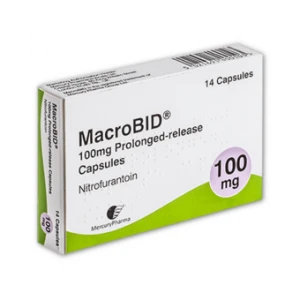


Nitrofurantoin (Macrobid) UTI Antibiotics
$26.74
Nitrofurantoin 100mg (MacroBID) is an antibiotic used to treat urinary tract infections (UTIs) and cystitis. You may have a UTI if you are experiencing a stinging sensation when you urinate, need to go more often, need to go more urgently, or have lower abdominal discomfort. It is a first-line treatment option for those looking for effective, safe, and reliable relief.
Delivery & Privacy
- Fast next‑day delivery to get your products as soon as possible.
- All items are packaged discreetly to maintain your privacy.
What is Nitrofurantoin 100mg?
Nitrofurantoin is an antibiotic used to treat uncomplicated urinary tract infections (UTIs), especially bladder infections (acute cystitis). If you have cystitis symptoms such as a burning sensation when you urinate, needing to go more often, or lower abdominal discomfort, nitrofurantoin is one of the most commonly prescribed treatments in the UK.
Nitrofurantoin is a highly trusted antibiotic that is usually very well tolerated. Because it acts specifically on the lower urinary tract, it is particularly effective for treating bladder infections rather than those elsewhere in the body. It’s usually prescribed as 100mg modified-release capsules, often known by the brand name MacroBID.
Understanding UTIs and Cystitis
Urinary Tract Infections (UTIs) occur when harmful bacteria or other pathogens infect the urethra, bladder, ureters, or kidneys. Most UTIs are caused when bacteria, commonly E. coli from the bowel, enter the urinary tract through the urethra. Sexual activity can increase the risk because it may move bacteria from the genital or anal area towards the urethra, although UTIs are not sexually transmitted infections. The most common UTI-causing bacterium is E. coli. Cystitis refers to inflammation of the bladder that commonly occurs during a UTI.
Women are at greater risk of developing a UTI when compared to men. This is because the urethra is much shorter in women, so bacteria have a shorter distance to travel to reach the bladder (where these bacteria can multiply). Sexual activity is a risk factor for UTIs because it can introduce bacteria from the skin to the opening of the urethra. However, it is important to note that UTIs are not sexually transmitted infections. Other risk factors include urinary tract obstructions, incomplete bladder emptying, and some chronic health conditions (such as diabetes).
How Does Nitrofurantoin Work?
Nitrofurantoin works by killing the bacteria responsible for your urinary tract infection. After you swallow the capsule, the medicine is absorbed into your bloodstream and then quickly filtered by your kidneys into your urine. This allows it to accumulate to high concentrations in the bladder, where most uncomplicated UTIs occur.
Once in the urine, nitrofurantoin enters bacteria and damages key components of bacterial cells, including their genetic material and proteins. This prevents the bacteria from growing and multiplying. As the number of bacteria falls, your body’s immune system can clear the remaining infection more effectively.
Because nitrofurantoin attacks bacteria in several ways at once, it is harder for resistance to develop than with some other antibiotics. This is one of the reasons it remains a first-line treatment for uncomplicated UTIs in UK clinical guidelines.
How Long Does Nitrofurantoin Take to Work on a UTI?
Women are usually prescribed a 3-day course of MacroBID capsules to treat an uncomplicated UTI. Most people notice an improvement in symptoms within 24-48 hours. However, some people may not feel fully better until they have completed the
course. You must complete the full course of nitrofurantoin, even if symptoms begin to resolve earlier, to reduce the risk of the infection returning. Antibiotics may become less effective in the future if infections aren’t fully treated.
Pregnant women and men who have cystitis are often prescribed a longer course of MacroBID, usually 7 days. It can also take longer for symptoms to resolve in these groups.
How Effective is Nitrofurantoin For UTIs?
Nitrofurantoin is considered both a reliable and well-established treatment for uncomplicated bladder infections. Many people begin to notice an improvement in symptoms within 24 to 48 hours of starting treatment.
Common symptoms such as burning when passing urine, urgency (an increased need to pass urine immediately), and needing to go more frequently often start to ease quickly. However, even if you feel better within a couple of days, it is important to complete the full prescribed course to ensure the infection is fully cleared. More information regarding the symptoms of cystitis can be found within our comprehensive guide.
Clinical studies report clinical cure rates of over 80% when nitrofurantoin is taken as directed. It is particularly effective against Escherichia coli, the bacterium responsible for most community-acquired urinary tract infections. Importantly, nitrofurantoin remains active against many strains that have developed resistance to other commonly used antibiotics.
Research comparing nitrofurantoin with treatments such as trimethoprim has shown similar or better outcomes in areas with higher trimethoprim resistance. A standard course of 100mg modified-release capsules taken twice daily has been shown to provide strong symptom relief, achieve effective bacterial clearance, and be well-tolerated when used appropriately.
How to Take Nitrofurantoin (MacroBID) Antibiotics
Nitrofurantoin should be taken exactly as prescribed by your clinician. For uncomplicated UTIs, the usual dose of modified-release nitrofurantoin 100mg is taken twice daily for 3 days. This is extended to 7 days for males and pregnant women. In some circumstances, a clinician may prescribe a different nitrofurantoin formulation or dosing schedule, depending on the infection and your individual circumstances. Your clinician will prescribe a treatment course tailored to your specific needs after reviewing your symptoms.
Capsules should be swallowed whole with water and taken with food or milk to help reduce stomach upset and improve absorption. It is important to complete the full course even if symptoms improve within a few days.
Nitrofurantoin Prescription Criteria
Nitrofurantoin is the first-line treatment of choice for uncomplicated lower urinary tract infections. It can be prescribed based on reported symptoms such as dysuria (pain when passing urine), urinary frequency, urgency (an increased need to urinate immediately), and suprapubic discomfort. Urine samples are sometimes taken to test for antibiotic sensitivities.
It is not suitable for suspected kidney infections and those with severely poor kidney function, widespread infection, or in late pregnancy (particularly at term and during labour or delivery), unless otherwise directed by a clinician.
Nitrofurantoin Dose for UTI
MacroBID 100mg is usually prescribed to take 1 capsule twice daily for 3 days for women, and for 7 days for men and pregnant women. However, this may be adjusted by your clinician based on your individual requirements (such as reduced kidney function or recurrent infections). It is important that you take your medication exactly as prescribed by your clinician.
When taking MacroBID (Nitrofurantoin) 100mg twice a day, space your doses by 12 hours. This means that if you take one dose at 7am, your next dose should be at 7pm.
What if You Forget to Take Nitrofurantoin Capsules
If you forget to take Nitrofurantoin (MacroBID) antibiotics when you should, there’s no need to worry. As long as you remember later on the same day, you can just take that day’s dose as usual. If you miss a full day’s dose, take your normal dose on the next day. If you are taking it twice daily, your next dose should be taken roughly 12 hours later. Do not take a double dose to make up for a forgotten capsule. Seek advice from your doctor or pharmacist if you are unsure.
What if You Take Too Much Nitrofurantoin
If you take more Nitrofurantoin capsules than you should, consult your clinician or doctor immediately, or go to the emergency department of your nearest hospital. Always take the container, label, and any leftover medication with you, so the medical staff know what you have taken and how much.
If You Stop Taking Nitrofurantoin
Your clinician will advise on the most appropriate Nitrofurantoin dose schedule for your circumstances. It’s important that you do not stop taking the antibiotics earlier than prescribed, even if you start feeling better or your symptoms have improved. Doing so could result in the infection coming back. Antibiotics may become less effective in the future if infections aren’t fully treated.
Nitrofurantoin Side Effects and Cautions
Just like all medications, Nitrofurantoin (MacroBID) antibiotics can cause side effects, though not everyone will experience them. Some may be minor and disappear relatively quickly, while others could be more serious and require you to stop taking the treatment altogether. Nitrofurantoin may not be suitable for everyone. It’s therefore important to have a clear understanding of what to expect before starting treatment.
Side Effects of Nitrofurantoin
Nitrofurantoin is usually well-tolerated. However, you may experience unwanted adverse effects. Contact your doctor if you are experiencing any side effects from Nitrofurantoin use. Alternative UTI treatments are available if you are unable to take MacroBID.
Nitrofurantoin side effects include:
| Rare
(may affect up to 1 in 100 people) |
Frequency Unknown |
|---|---|
|
|
Please note that the above list does not contain all the potential side effects of Nitrofurantoin. Further information can be found within the Patient Information Leaflet included with the treatment. You can also report all adverse reactions to the MHRA’s Yellow Card Scheme.
How Long Do Nitrofurantoin Side Effects Last?
The majority of side effects from Nitrofurantoin use only last for as long as Nitrofurantoin remains in your body. It may take several days for the drug to be fully excreted and for the side effects to resolve. Rarely, more severe side effects can persist for some time after termination of treatment, requiring clinician intervention. If you are concerned about ongoing side effects from Nitrofurantoin use, speak to your doctor.
When to Stop Taking Nitrofurantoin
You should stop taking Nitrofurantoin (MacroBID) capsules and seek urgent medical advice if you experience any of the following:
- Blue or purple skin tone, caused by low oxygen levels
- Fever, chills, cough, and shortness of breath associated with pneumonia
- Jaundice (yellowing of the skin and whites of the eyes)
- Raised pressure in the skull (severe headaches)
- Unexplained weakness, bruising, or systemic infections
- Fever, flu, abdominal pain, diarrhoea, blood in your stool, and weakness
- Fatigue, abdominal pain, joint pain, and swelling
It is normal for your urine to become quite dark during treatment with Nitrofurantoin. You do not need to stop taking the medication if this happens.
Nitrofurantoin (MacroBID) Interactions and Warnings
Although Nitrofurantoin (MacroBID) is an effective treatment for UTIs, it is not suitable for everyone. The medication could interact with other medicines or herbal remedies that you’re taking, or not be safe if you have certain medical conditions.
Do not take Nitrofurantoin 100mg capsules if:
- You are allergic to nitrofurantoin, other nitrofurans, or any of the other ingredients in the medication. Signs of an allergic reaction include skin rash, hives, swelling of the eyelids, face, lips, arms, or legs, and difficulty breathing or swallowing
- You have a disease of the kidneys that is severely affecting the way they work (ask your doctor if you are not sure)
- You are in the final stages of pregnancy (labour or delivery), as there is a risk that it might affect the baby
- You have porphyria (a blood disorder).
- You have G6PD (glucose-6-phosphate dehydrogenase) deficiency
- You are breastfeeding a baby with a suspected or known G6PD (glucose-6-phosphate dehydrogenase) deficiency.
Precautions Before Taking Nitrofurantoin
Your doctor will want to carefully review your medical history to determine whether MacroBID capsules are right for you. Tell your doctor if any of the following apply to you:
- You have diabetes
- You are suffering from any illness causing severe weakness
- You have anaemia (a decrease in red blood cells, causing pale skin, weakness, and breathlessness); a lack of vitamin B or abnormal levels of salts in your blood (your doctor will be able to advise you)
- You have a history of allergic reactions.
- You have any problems with your kidneys
- You have a disease of the lungs
Nitrofurantoin may cause lung disease in individuals with no history of lung disease. Talk to your doctor if you experience trouble breathing, shortness of breath, a lingering cough, coughing up blood or mucus, or pain or discomfort when breathing.
The following conditions may increase the likelihood of developing a side effect that causes damage to the nerves and an altered sense of feeling, like pins and needles:
- You lack an enzyme called glucose-6-phosphate dehydrogenase
- You have any disease of the lungs, liver, or nervous system
Dark yellow/brown urine can be normal on its own, but seek urgent advice if dark urine occurs with symptoms such as yellowing of the skin/eyes, pale stools, severe tiredness, abdominal pain, nausea/vomiting, itching, or joint pain. This may be a sign of a serious liver condition.
MacroBID contains lactose and sucrose. If you have been told by your doctor that you are intolerant to some sugars, seek advice before taking this medication.
Nitrofurantoin and Other Medications
You must tell your prescribing clinician if you are taking (or have recently taken) any other medications, including those bought over-the-counter, supplements, and herbal remedies. The following groups of medications may interact with Nitrofurantoin:
- Antacids for indigestion
- Medicines for gout
- Medicines for raised pressure in the eye (glaucoma)
- Medicines that make the urine less acidic
- Quinolones (a type of medicine that treats infections)
- Typhoid vaccine
Where Can I Buy Nitrofurantoin in the UK?
If you suspect that you have a urinary infection, access to prompt and effective treatment is essential. MacroBID can be purchased from licensed pharmacies with a valid prescription from an appropriately trained medical provider. It is important to use a reputable pharmacy you can trust when buying medications. The General Pharmaceutical Council keeps an up-to-date register of licensed pharmacies.
Can I Buy Nitrofurantoin Over the Counter?
In the USA and UK, you cannot buy Nitrofurantoin over-the-counter without a prescription. A medical consultation is required to ensure that Nitrofurantoin is suitable for you. Inappropriate use of antibiotics may contribute to antibacterial resistance, making infections more difficult to treat in the future.
Is Nitrofurantoin Available on the NHS?
Nitrofurantoin is regularly prescribed by NHS clinicians to treat UTIs. When prescribed under the NHS, the standard prescription charge and any valid exemptions apply. MacroBID is a brand name for a form of modified-release nitrofurantoin. You may be offered an alternative generic form of Nitrofurantoin, or an alternative antibiotic when seen by an NHS clinician.
Can I Buy Nitrofurantoin Online?
Yes, you can buy Nitrofurantoin (MacroBID) online safely and securely from reputable pharmacies like United Pharmacy Shop. With us, there’s no need for an appointment, as you can start a consultation at any time from the comfort of your own home. Simply complete a brief medical questionnaire, and our team will take care of the rest.
Frequently Asked Questions About Nitrofurantoin (MacroBID) 100mg
Does Nitrofurantoin Contain Penicillin?
Does Nitrofurantoin Make You Urinate More?
Nitrofurantoin is filtered by the kidneys and excreted in the urine, but it does not directly increase urine production. Urinary tract infections themselves commonly cause symptoms such as urinary frequency and urgency, which may make it feel like you need to urinate more often.
Drinking adequate fluids may help lessen discomfort when passing urine. One point to note is that nitrofurantoin may change your urine colour to a dark yellow/brown. This is normal, and your urine will return to its usual colour once you stop taking it.
What Can You Not Take with Nitrofurantoin?
Certain medicines may interact with nitrofurantoin. Antacids containing magnesium trisilicate can reduce its absorption. Probenecid and sulfinpyrazone, used for gout, may decrease drug removal from the kidneys, increasing the risk of side effects. Medicines that affect kidney function may impact whether nitrofurantoin is suitable for your circumstances.
You should inform your clinician about all prescription medicines and over-the-counter products you are taking before starting treatment. Nitrofurantoin is generally avoided in patients with significantly impaired kidney function because it is less filtered by the kidneys and can therefore accumulate in other parts of the body.
Nitrofurantoin vs Trimethoprim: Which is Best?
Both nitrofurantoin and trimethoprim are used to treat uncomplicated UTIs. The most appropriate choice depends on several factors, such as the patient’s allergy history, kidney function, and previous antibiotic use. Previous antibiotic use is important because if you have used one before, you may be more likely to develop resistance.
In the USA and UK, nitrofurantoin is often preferred as first-line treatment because trimethoprim resistance rates are higher in many regions. Your clinician will determine the most suitable option based on your individual circumstances, local resistance patterns, and clinical assessment.
Can You Drink Alcohol While Taking Nitrofurantoin (MacroBID)?
Can I Drive or Operate Machinery with Nitrofurantoin?
Is Nitrofurantoin Safe in Pregnancy and While Breastfeeding?
Will Nitrofurantoin (MacroBID) Affect My Contraceptive Pill?
Can Nitrofurantoin Cause Thrush?
What Should I Do if Nitrofurantoin is Not Working for UTIs?
Can I Take Pain Relief with MacroBID
Related products






Reviews
There are no reviews yet.